How I Homeschool Pre-K Through High School
I probably shouldn’t say this, but homeschooling is rarely an easy pursuit. We know this because we’ve had our fair share of ups and downs over the years.
Part of who we are as homeschoolers today is simply because of the experiences we have had in the past – so I would never wish those moments away. Both good days and bad days have shaped our homeschool experience and helped us along the way.
And, as a homeschool Mom teaching grades pre-K through high school, I for one, will forever be grateful.
Humble Beginnings
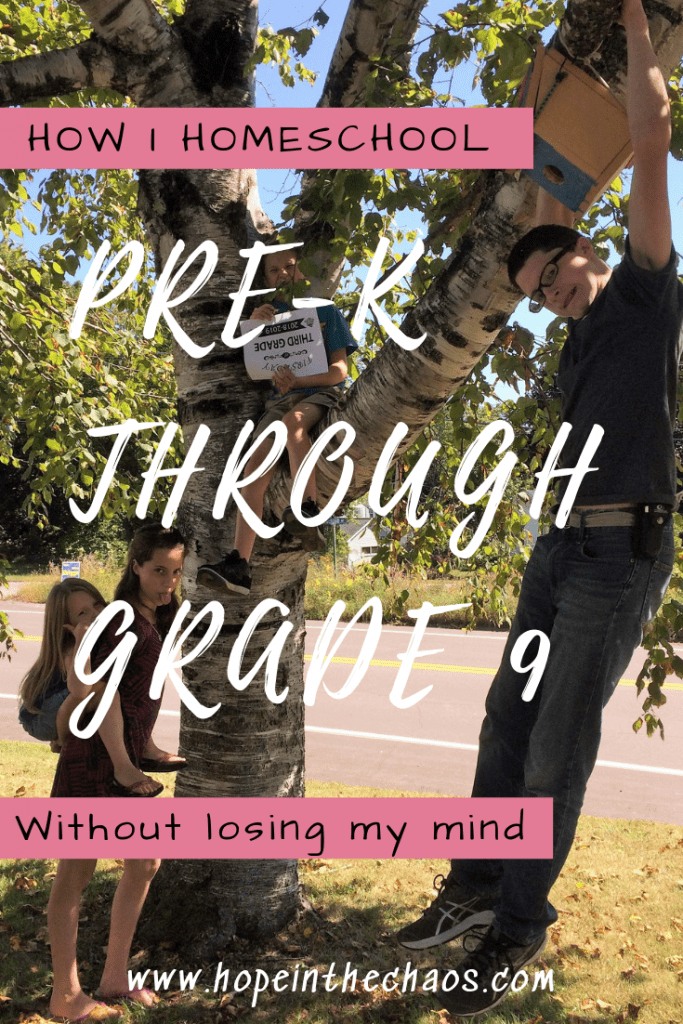
There was a time when I only had three homeschooled students. In those days, the gap seemed easier somehow, even with a one-year-old in the mix.
Pre-k was simple, taking about an hour a day on an ambitious day (oh, and did I mention that I was super ambitious back then?) We started our days together then the older kids broke off to work independently while I worked with the youngest student and kept the baby occupied.
Over the years, our approach to homeschooling has changed – there’s no doubt about it. We’ve adapted as the materials changed, shifted with new or different interests, and changed when we learned new ways of doing things.
Not every day has gone smoothly, despite my best efforts… yet we were learning so much more than just the lessons in our books. Every day we have learned about our homeschool and about what worked for us and what didn’t.
And just when we thought we had it figured out, something came along that required us to change our approach and try something new.
Yet, with just three kids who were homeschooled the juggling became, dare I say, fairly easy. Foundations and basics for the younger student, combining classes for all three where we could, and a mix of pushing the older kids as well as following their own interests. Toss in some inclusion for the youngest child, and most days went well enough.
Time For Something New
However, just when things start to level off and I think that I can rinse and repeat, change comes along to keep me on my toes and prevent me from feeling too confident as a homeschool mom.
The first was the start of high school for the oldest child in our home. We started planning for this months ago while he was still in eighth grade.
Initially, the planning looked a lot more like long conversations about his goals and dreams for high school and after. Then we began the process of exploring and considering a wide range of classes so we could cover core items and electives, while also considering future plans.
I also spent a lot of time researching state laws, graduation requirements, and even checking enrollment information on college websites.
All the while, my youngest became interested in having a more formal role in our daily schooling activities. Having turned four, she wanted to be part of
So last fall I set out to start not just a new homeschool year, but a year with new grade levels, new requirements, a new “official” student, and our largest grade gap ever.

A Typical Day In Our Multi-Grade Homeschool
First, I should probably tell you that no two homeschooling days are ever the same. When I say a “typical” day, I’m talking about how most of our days go… our preferred routine. As a homeschooler yourself, I’m sure you are quite familiar with the many changes that can happen from one day to the next. And I’m pretty sure you are accustomed to the many moments that simply require you to make a decision, change course, or simply veer from what you thought the day might bring.
Starting Out
A huge fan of the morning basket, we start our homeschool day with our unique adaptation of this beloved Charlotte Mason practice. This is where we read books together, work on geography, and update our daily calendar.
And while the older kids often would prefer to skip out and do their own thing, in our homeschool we know how important books are! I do my best to select titles that will work for all of the kids and keep reading time interesting.
These are the moments I can snuggle in on the couch with the younger kids and spend a few unhurried minutes of the day. The time we can all venture to faraway places and explore new worlds.
It’s also a great time to work on core learning items such as reading comprehension, public speaking (yes, the kids do take turns reading aloud), vocabulary, geography, and so much more!
Speaking of geography, our morning time gives us the opportunity to work on this all-important topic in easy ways!
First, we start with our world map and find where in the world our stories are taking place (as best we can). We have had some great conversations in front of this map about places from Japan to Australia, England to Peru, and even Antarctica.
Our next stop is our US map where we work on the states. This started because at the beginning of our school year hubby was in North Carolina and my daughter wanted to see just where Daddy was. So we spent some time learning where
And last is the calendar. Here we work on months of the year, days of the week, and concepts like yesterday, today, and tomorrow. We talk about upcoming holidays, birthdays, and other special events. The best part here, my third grader is often the one taking the lead and teaching his sister the same concepts I was just teaching him not so long ago.

Independent Courses
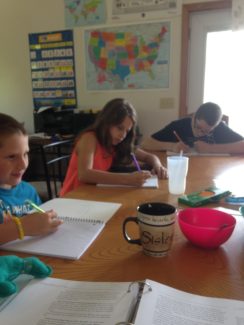
Following our short and simple morning basket routine, it’s time to start on some workbooks and lessons. For my third grader that includes math, grammar, and science.
While typing it out seems like it may be a long list, it’s actually not. The programs we use allow us to complete most of the work in 10-15 segments of time. We break it up by not jumping immediately from one course to another but instead opt to go from math to playing for a few minutes, or grammar followed by a quick snack. And some days, I work with one of the kids, then the other, giving them each built-in breaks.
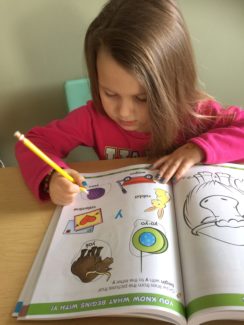
For the youngest one, unless we are working on a review item, her days consist of a page or two in her big book of pre-k facts. She loves this book and dutifully sits at a desk tickled pink she’s doing school.
On days she doesn’t feel like working in her workbook, we either grab a free printable online, like these animal tracing worksheets or we take the day off. Simply put, I have no interest in making learning anything other than fun for her at this age.
While I am busy working with the younger kids, the older kids are typically starting their independent courses as well.
As much as I love combining courses, some simply need to be done separately.
My daughter who is in the eighth grade this year loves to start her day, and her schoolwork, early. It’s super common for her to have completed at least one subject before the rest of us have even started. Out of all of the kids, she is the busiest without side interests and she loves to not only create a plan for her day but follow it.
Time To Mix It Up With Combined Courses
Yes, combined courses for all four of my kids. “How is this possible?” you might ask. To that I simply say, don’t knock it until you try it. 😉
Quite simply, a combined course is one where I am able to teach all of my kids at the same time and for
After starting out our morning we make a simple transition just before lunch. I try to time this so I’m not completely interrupting someone mid-lesson or even mid-thought. We all gather, either in the living room or at the kitchen table to work on history – together. How? Well, we use two main resources for history – Mystery of History and Drive Thru History – and both of these programs are geared towards multi-level learning. They are programs created to allow you to teach more than one grade, more than one student at a time.
We read or watch the lesson for the day then start with the discussion portion of the day. This is where I can actively see what each of the kids managed to learn.
Some days these discussions are great – everyone pays attention to the lesson and everyone is participating.
Other days… well, other days we all fall flat on our faces. It’s all par for the course. 😉
From here we branch out if someone has more they want to learn. We might do some additional research, work on a project, or even write papers. It truly depends. However, we all work on history together.
From here we jump into the main focus of our Language Arts curriculum which includes reading and writing. We love to follow a Brave Writer-styel for writing including lots and lots of freewrites.
Language Arts typically takes us right up to lunch (and sometimes after). From there, we all enjoy some free time before the older kids return to whatever individual lessons they may have. For my 9th grader, this almost always includes his math as he spends his morning time working on science and his electives. If the older ones need any real major assistance with a particular skill or subject this is also the time that I make sure to get them the help they need. The younger ones are free most afternoons to explore, create, dream, and wonder.
Electives, Extras, and Following Passions

So, if you haven’t noticed, I pretty much only hit the four core subjects of math, history, Language Arts, and science. And I did that for two reasons.
One, this is where the majority of my focus is spent.
And two, there is no possible way to explain, in a simple, easy-to-follow way, everything we do… plus, it does change.
But, in order to fully educate my
- Band lessons
- Vocal lessons
- Musical performances
- Computer coding
- Drawing
- Sports including soccer, cheering, field hockey, and track
- Scouting

Yet the biggest thing I do for my kids is to make sure they have time, and plenty of it, to pursue those adventures that spark their interests.
Everything from letting them research sea creatures to giving them ample supplies for crafting and drawing. Time and encouragement to ask the questions, look for solutions, and get their hands dirty actually learning.
Time away from a strict schedule or even a routine that’s restrictive and instead allows them the freedom to take themselves where their curiosity leads them.
Oh yeah, and if I haven’t mentioned it enough, books. We live for books and on those days when the schedule is packed and we can’t possibly get it all in, we start with a story and simply do the best we can.
Homeschooling Pre-K Through High School
So far, the year has gone well.
I have watched all of my children learn and grow and take on new challenges I couldn’t even have imagined while homeschooling a teenager, two big kids, and a toddler.
We have had good days and bad days, and even some in-between days. Days where the learning happened quickly, easily, and relatively routinely and days where homeschooling was a struggle.
Yet, as I stated in the beginning, I wouldn’t change anything one bit. Homeschooling through the chaotic times is just as important as homeschooling through the easy ones. And as we embark on the final leg of a year filled with many new firsts, I hope that we all can recall more of the good days than the bad ones. That we all can see how far we have grown regardless of the number of lessons actually completed.
And most importantly, I hope you can see that it is possible to homeschool pre-k through high school.

Feeling Lost In Your Homeschool Journey?
Join me today in Hopeful Homeschoolers on Facebook!


Kelly Warner is a seasoned homeschooling mom from Maine, where she lives with her husband and their four children—two of whom are proud homeschool graduates. With years of experience navigating the ups and downs of home education, Kelly is passionate about helping families simplify their journey and find encouragement amidst the chaos of daily life. She shares practical tips, inspiration, and real-life homeschooling wisdom on her website, Hope In The Chaos, and across social media.


