Back To The Basics: The Importance of a Homeschool Foundation
Whether you are a brand new homeschooler or a seasoned veteran we can all agree on one thing: a good foundation for your homeschool is vital. Yet what this looks like and what items are needed for a good homeschool foundation will vary based on who you ask.
Today I want to talk about some common items that I see parents wondering if they can skip out on. Things that seem like they can easily be pushed aside.
Yet items that I truly believe are vital to a good education and, more importantly, instrumental in creating a solid homeschool foundation for your children to build on.
Homeschool foundation – That sounds restrictive
Homeschoolers. You have to admit, we are a kind of unique breed. On one hand, we dare to buck the system and go our own way. We take control of the educational future of our children and place the responsibility squarely in our own hands.
Yet, on the other hand, there is a little bit of fear and anxiety. Worry that we may mess this up. Concern that we may skip something so monumental our children will never be able to function in society properly.
It’s quite the catch-22.
Thankfully, in our modern society, we are never alone. Even if we are home all day long with our children, we can reach out to other homeschoolers in many ways. One common method is online. Through the power of the internet whole communities are formed that allow homeschool parents to connect, share ideas and experiences, vent frustrations, and of course, ask all the questions… because as we all know, there are a lot of questions.

One question in particular that I keep seeing lately is about foundational items. Things like the memorization of math facts, the best approach to teaching reading, and even teaching cursive handwriting are being commented on and discussed daily.
And these are good discussions to have.
It’s important that we think about why we are teaching some things and where they fit in a home education.
My concern though, as these parents wonder about skipping out on some of these things, are the future ramifications. Sure, you may be able to finish up your school day a little early now, but what happens later down the road?
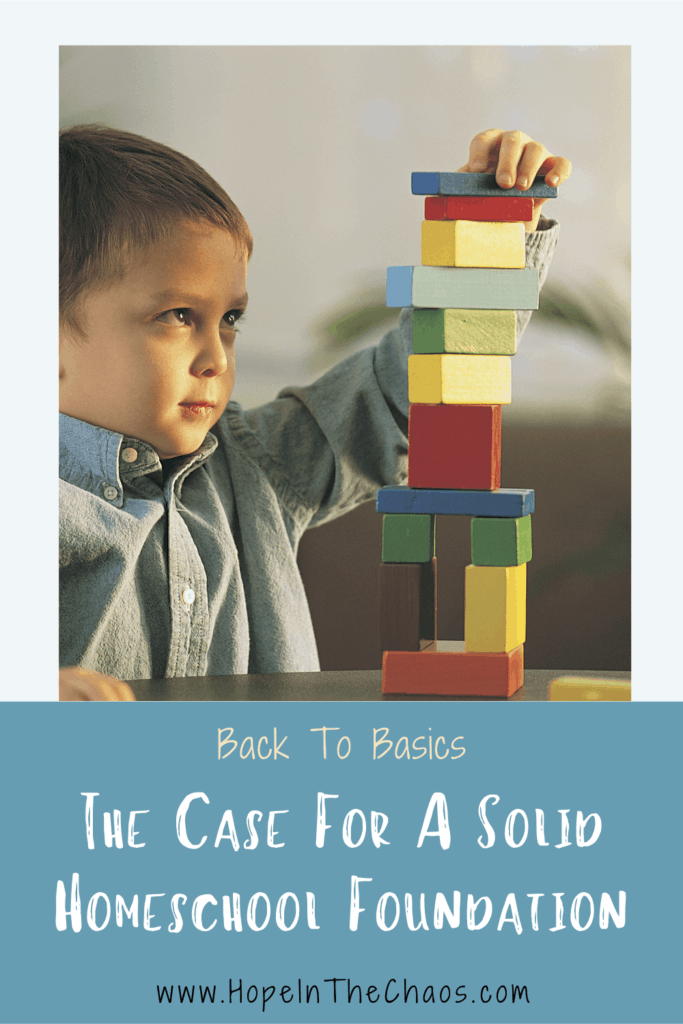
Laying A Good homeschool Foundation, One Piece At A Time
[bctt tweet=”Much of early childhood education is about building a foundation.” username=”hopeinthechaos”]
Much of early childhood education is about building a foundation. Just like any building out there is only as good as it’s foundation, the same is true of your child’s education.
The problem lies in skipping out on the foundational pieces. You know, the basics.
If you don’t start with the basics you can’t add a lot more to it. And while we have a lot of freedom as homeschoolers, we should not neglect to lay a good foundation from day one.
Honestly, this is not something you should skip or neglect.
What Does A Homeschool Foundation Mean for Language Arts?
What does this mean for homeschool parents? It means a lot of repetition. A lot of teaching the same idea or skill over and over again, sometimes for several years.
My second grader, for example, is learning what a noun is for the third year. Now each year we have studied this concept he had gotten it. Yet by the following year, he cannot recall what a noun is or why it is important.
So each year, since kindergarten, we have learned about nouns. The first year, it was simply what a noun was. The second year, we covered what a noun was along with common and proper nouns. This year, we are starting at the basics of what a noun is, then common and proper nouns, and finally, we are starting in on singular and plural nouns.
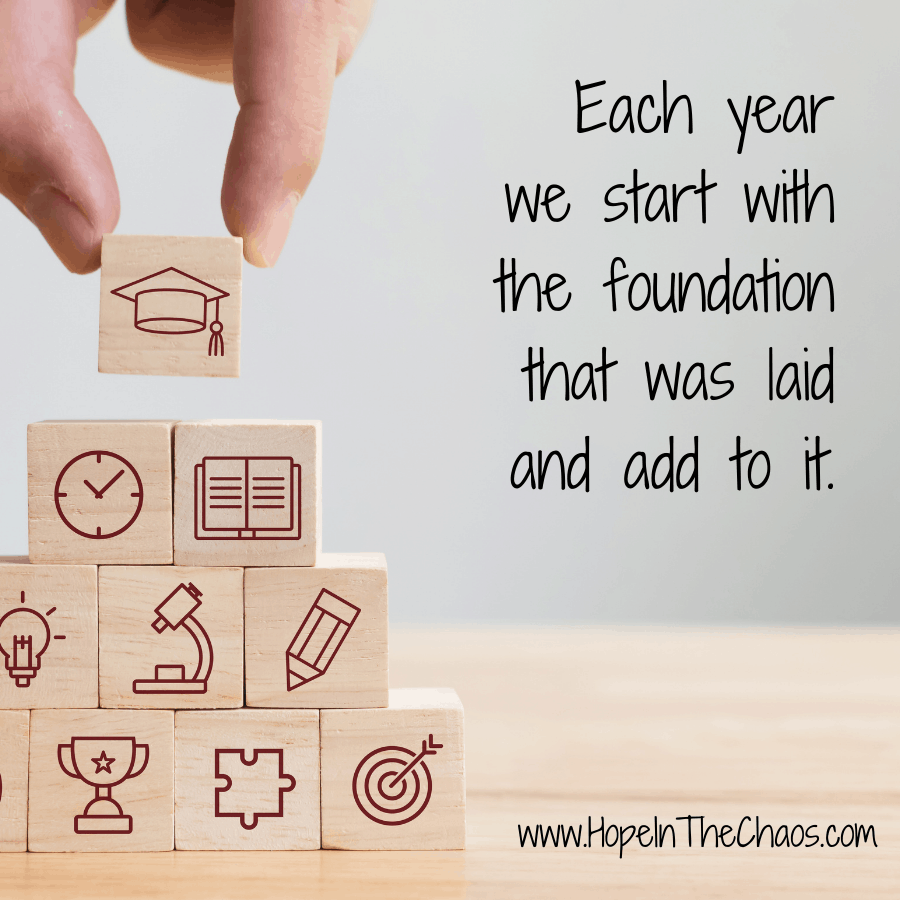
Why are we doing this? Because each year we are starting with the foundation that was laid in kindergarten and then building onto it.
It’s not enough to simply teach him once that a noun is a person, place, or thing. No, each year I need to make sure that foundation is shored up and secure before I can add to it.
And one of these years, we just may not need to go back over what a noun is. One of these years, when we get to parts of speech, he will remember what a noun is because we are working so diligently on that foundation.
What Does A Homeschool Foundation Mean For Math?

Math. You either love it or you hate it, but you have to admit a certain level of math is necessary for each of us. It is typically a subject that many parents cringe at the thought of teaching though because either they have horrific memories of math class, or, a complete disdain for the subject as a whole.
Sadly, one other issue I commonly see popping up as well – even though my high school math teachers said this would never happen – is that most people tend to carry around a calculator in their pockets in the form of a phone.
And now, many parents are wondering if they should be spending time memorizing the basics of math with their children, especially with those who struggle.

The problem with skipping memorization though is that a lot of the items we memorize as our basic facts are the things that we want to come to memory quickly. It’s like saying we want to be a good typist or keyboardist but we don’t want to spend the time memorizing our homerow keys.
Memorization is not an easy thing to do with your child. As with much of the foundational items, it requires a lot of repetition.
Honestly though, the early years of a child’s education are about building a foundation. It’s about repeating lessons and working on memorizing items that will be used year after year.
Starting with a good foundation in math is imperative to being able to move on to more advanced concepts in the later grades.
[bctt tweet=”Each step relies on learning the previous one.” username=”hopeinthechaos”]
Think of it this way: Even before your child started school you taught them how to count.
Then, the ability to count allows your child to learn to group the numbers.
From there you move on to skip counting.
Then you move on from skip counting to addition, combining numbers to make them larger.
From there, you work on subtraction.
Yet none of this would have been possible if you hadn’t started with the simple concept of numbers and counting.
Each step relies on learning the previous one – this is the foundation of homeschooling.
Continuing to Build That Math Foundation
Even once your child is good with numbers, adding, and subtracting, you still have work to do.
You see, math has a large foundation and all of elementary school is about building it.
Once the basics are understood, you then move on to harder items such as multiplication, division, and fractions.
This is the second layer of a good math foundation and one that I often see parents thinking about skipping: that is multiplication.
When I was a student, memorizing my multiplication tables was a standard item. There was no question about it.
Today, though, many parents feel this is futile.
And while homeschooling does allow us a bit of flexibility, the memorization of these basic math facts is not something I believe can be skipped – even when it is challenging.
Just like you taught your child to add in their head, rather than on their fingers, encouraging them to memorize their multiplication tables will be super beneficial later in math.
Yet, just the other day I saw a parent ask if she should bother having her child memorize them since we live in an age where calculators are easily accessible. Her thought process was that the child wouldn’t need to memorize since the answers would be right in their pocket.
That might be true but do you really want to pull out a calculator every time you’re trying to figure out 10% off an item or if you’re standing at the checkout trying to quickly add up your purchases? I really don’t think so.
I can tell you as a parent and homeschooler that there are times I can help my oldest son with his algebra faster than he can open his tablet turn the calculator app on and find the answer. We do it as a joke and it also reinforces the fact that memorizing the basics does make things easier.
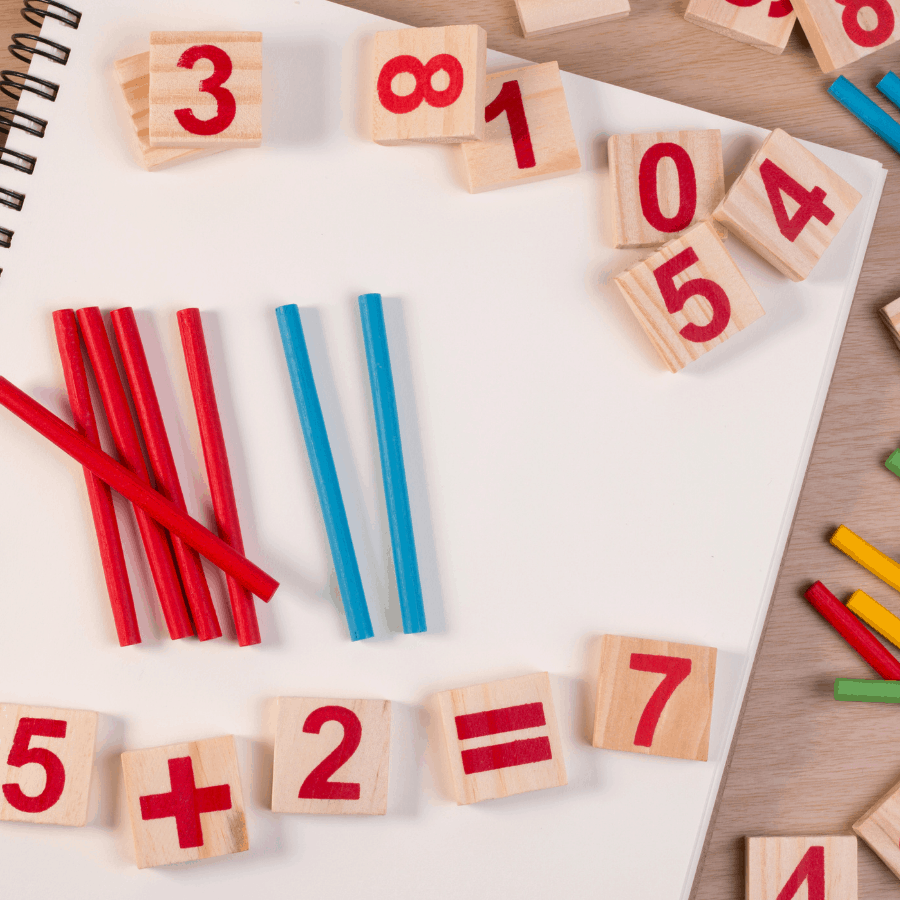
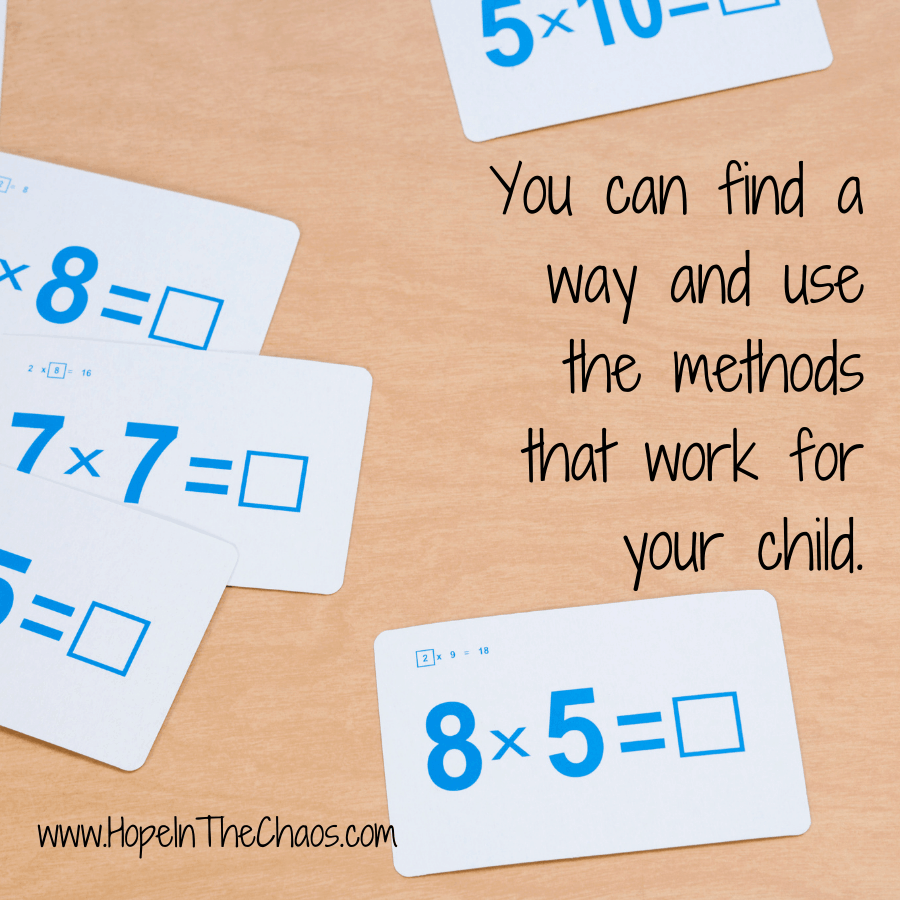
For us, one of the best and easiest ways to approach memorization was to turn it into a game. Using both flashcards and “minute math” I encourage my youngest son to beat himself in both the number of problems completed and accuracy. It’s a break from the mundane worksheets, and for him it’s fun.
Will memorization always be easy or be completed in the 3rd grade? No. And that’s OK. The key is not to check this item off in a particular grade level, rather it’s to continue working on it a little at a time.
The best part is that how you do this is up to you. You can find a way and use the methods that work for your child and your homeschool preferences. You can continue to encourage learning and show your child that even if it’s challenging, it’s doable.

Handwriting, To Teach or Not To Teach
I don’t know about you, but I can still remember walking into third grade to see a strange form of letters up above the chalkboard. These letters looked similar to the typical ABC’s of the younger grades but had some slight variations.
Yup. This was the year I was introduced to cursive.
Fast forward to today, and many public school kids never even learn the basics of either printing or cursive. When I was younger not only did you learn cursive, but by middle school, you were expected to complete most of your work in cursive.
Today, computers have taken center stage and surpassed handwriting as the preferred form of drafting papers and completing assignments. In younger grades, children are urged to learn proper typing habits and as a result, many schools left penmanship and cursive handwriting by the wayside.

Now, I’m not saying that your child should be writing in full on calligraphy but, learning how to write properly is still important.
And I do believe that cursive is as well. Not only can it improve your child’s penmanship, but it will also allow them to learn a proper signature. Historic documents such as the Declaration of Independence, The U.S. Constitution, and the Gettysburg Address are all written in cursive handwriting.
Find a book, or a workbook, or even some sheets online and start teaching your upper-elementary student cursive. Even if they don’t use it as their primary form of handwriting, and even if they balk at the idea, it will be a great foundational step to their education.
Without A Foundation, It Will Crumble
The fact of the matter is, without the basics, your child’s education has the potential to crumble. And while parents who think of passing on these items are well-meaning, I think it would behoove us all to reconsider what we think of about an education.
There is something to be said for going back to the drawing board and learning from our elders. There is something to be learned from the past. If today’s public education climate tells us anything, it’s that the basics are not being taught and they are more important than ever.
So even if you are covering addition for the one-thousandth time. And even if you are teaching nouns for the third or fourth year. And, yes, even when your child complains at the thought of a cursive Z, remember, this is for their benefit. This is for their future.

What foundational items do you make sure to include in your homeschool? Be sure to let me know in the comments below!

Kelly Warner is a seasoned homeschooling mom from Maine, where she lives with her husband and their four children—two of whom are proud homeschool graduates. With years of experience navigating the ups and downs of home education, Kelly is passionate about helping families simplify their journey and find encouragement amidst the chaos of daily life. She shares practical tips, inspiration, and real-life homeschooling wisdom on her website, Hope In The Chaos, and across social media.


